Facts
Official figures, not averaged.
Two official answers to “are we still in an ice age?”, more than one sea-level sentence, and three official dates for the start of the present interglacial.
Official figures, kept in their original wording. Where two pages disagree, both rows stay.
| What | Official wording | Source |
|---|---|---|
| Are we in an ice age? (NASA Earthdata) | “Correctly speaking, Earth remains in an ice age.” Today is “an interglacial period, a relatively warmer period of the current ice age.” | Jane Beitler, 28 December 2020 [source] |
| Are we in an ice age? (USGS image title) | “We're not in an ice age at the moment, but ice caps are still present.” Last ice age “about 20,000 years ago.” | USGS, 28 January 2019 [source] |
| Last glacial maximum, date | About 20,000 years ago (USGS fs2-00 and FAQ); “peaked* around 20,000 years ago” (Climate.gov); “roughly 20,000 years ago” (NSIDC) | [source] [source] [source] [source] |
| Sea level at the LGM (fs2-00) | “About 125 meters below today’s sea level” (Fairbanks, 1989) | USGS [source] |
| Sea level at the LGM (USGS FAQ) | “More than 400 feet lower than it is today” | USGS [source] |
| Sea level at the peak (NASA Earthdata) | “400 feet lower than they are today” | [source] |
| Ice extent then and now (USGS FAQ) | Then: 8% of Earth’s surface, 25% of land, 33% of Alaska. Today: 3%, 11%, 5% of Alaska. Retreat began about 15,000 years ago; sea level reached current height about 8,000 years ago. | [source] |
| Holocene start (USGS fs2-00) | The most recent interglacial “started about 10,000 years ago” | [source] |
| Most recent glacial period (NOAA NCEI, October 2021) | Between about 120,000 and 11,500 years ago; since then, the Holocene interglacial | [source] |
| Informal “ice ages” | Cold periods “informally referred to as ‘ice ages,’ or ‘glacials’,” on roughly 100,000-year cycles for at least the last 1 million years | Climate.gov, 29 October 2020 [source] |
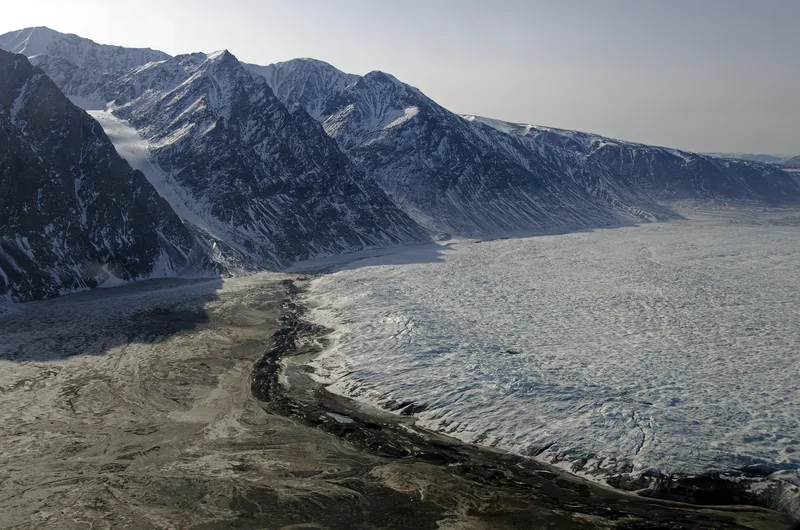
| Laurentide Ice Sheet | Covered much of North America at the LGM; its weight created basins that now hold the Great Lakes. Only two ice sheets remain: Antarctic and Greenland. | NSIDC [source] |
| Antarctic ice thickness (science-of-glaciers) | Over 4.7 kilometres (3 miles) thick in some areas | NSIDC [source] |
| Little Ice Age (Met Office Factsheet 5, 2025) | Conventionally 16th to 19th centuries; particularly cold intervals beginning in about 1650, 1770 and 1850 | [source] |
| Little Ice Age (NASA soot release) | “Loosely defined as a cooler period between the 14th and 19th centuries” | [source] |
| Maunder Minimum (NASA Earth Observatory, 15 November 2006) | 1650–1710, a quiet solar phase “already in the midst of” the Little Ice Age, not the full span | [source] |
A NOAA GML classroom sheet that says the last ice age ended about 12,000 years ago is quoted only as a labelled contrast, on the field-notes page, and is not used as a source for orbital causes.
Enjoyed a desk of official ice-age wording, unblended, and the marks glaciers still leave?
No pop-ups. No intrusive advertising. Just interesting stuff. A little support helps the next climates.im site get built.