Close to home
Ice Age Britain and the Isle of Man
About 27,000 years ago, two thirds of Britain and Ireland lay under ice, and a land now under the North Sea joined Britain to Europe. One of its animals stands in a museum on the Isle of Man.
The British-Irish Ice Sheet
Ice has covered Britain and Ireland several times. AntarcticGlaciers.org lists three big glaciations: the Anglian, between 478,000 and 424,000 years ago, the Wolstonian, between 300,000 and 130,000 years ago, and the Devensian, at about 27,000 years ago during the Last Glacial Maximum. [AntarcticGlaciers.org] At its height the Devensian ice sheet covered about two thirds of Britain and Ireland. It shrank after 27,000 years ago and had completely gone by 11,300 years ago. [AntarcticGlaciers.org]
Working out how it grew and melted was a big job. The British Geological Survey describes the five-year, £3.7 million BRITICE-CHRONO project, which spent 1,500 days in the field, collected 18,000 kilometres of marine geophysical data and 377 cores of sea-floor sediment, and produced 690 new dates, building a timeline between 31,000 and 15,000 years ago. [BGS] The team also produced maps of the ice’s extent, thickness, speed and flow at thousand-year steps, and found its behaviour strongly similar to Antarctica today. [BGS]
Doggerland: the land under the North Sea
Doggerland once joined Britain to mainland Europe, before rising seas drowned it and made today’s North Sea. [University of Warwick] A University of Warwick team used sedimentary ancient DNA from 252 samples in 41 marine cores along a prehistoric river to rebuild its plant life from around 16,000 years ago to its final flooding. [University of Warwick]
The results surprised them. Oak, elm and hazel were there more than 16,000 years ago, thousands of years earlier than British pollen records suggest, and they even found DNA from Pterocarya, a walnut relative thought to have vanished from north-western Europe 400,000 years ago. [University of Warwick] Parts of Doggerland survived the Storegga tsunami around 8,150 years ago and stayed above water as late as 7,000 years ago. [University of Warwick] Lead author Professor Robin Allaby said the wooded land could have supported early Mesolithic communities, which may help explain why so little early Mesolithic evidence survives on mainland Britain. [University of Warwick]
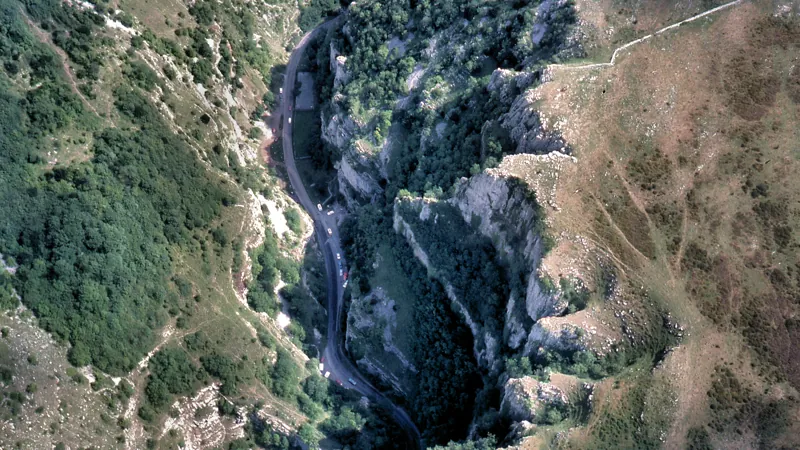
Cheddar Gorge, above, is the setting for Gough’s Cave, where Britain’s oldest almost complete skeleton of our species was found. The story is on People of the Ice Age.
The giant deer of the Isle of Man
The Manx Museum has a significant and very complete giant deer skeleton. [Manx National Heritage] Manx National Heritage says the deer, often called an Irish elk because so many have been found in Ireland, was dug out in 1897 from a marl pit at Close y Garey near St John’s. [Manx National Heritage] The dig was led by P. M. C. Kermode and a group known as the Elk Committee; Kermode later became the Manx Museum’s first curator. [Manx National Heritage] The skeleton is 1.7 metres tall at the shoulder, with antlers spanning more than 2.6 metres. [Manx National Heritage]
When conservators took it apart in 2015, they found the careful work of Caleb Barlow of the Natural History Museum in London, who came to the island in the summer of 1897 to put the skeleton together. They cleaned the bones with a laser, and in April 2016 the deer became the centrepiece of the museum’s new Geology Gallery. [Manx National Heritage]
Three tiny bone samples were radiocarbon dated by the Oxford University Radiocarbon Accelerator Unit. The dates agreed, and show the deer died about 14,500 years ago, more than four thousand years before the earliest evidence yet found of people living on the island. [Manx National Heritage] On the evidence found so far, the Manx deer is older than any trace of people on the Isle of Man.
Two antler figures: the Natural History Museum gives males antlers up to three and a half metres across. The Manx skeleton’s antlers span over 2.6 metres. One is the species’ upper end, the other is one real animal.
The rest of the giant deer story is on Ice Age giants.
Enjoyed a desk of official ice-age wording, unblended, and the marks glaciers still leave?
No pop-ups. No intrusive advertising. Just interesting stuff. A little support helps the next climates.im site get built.